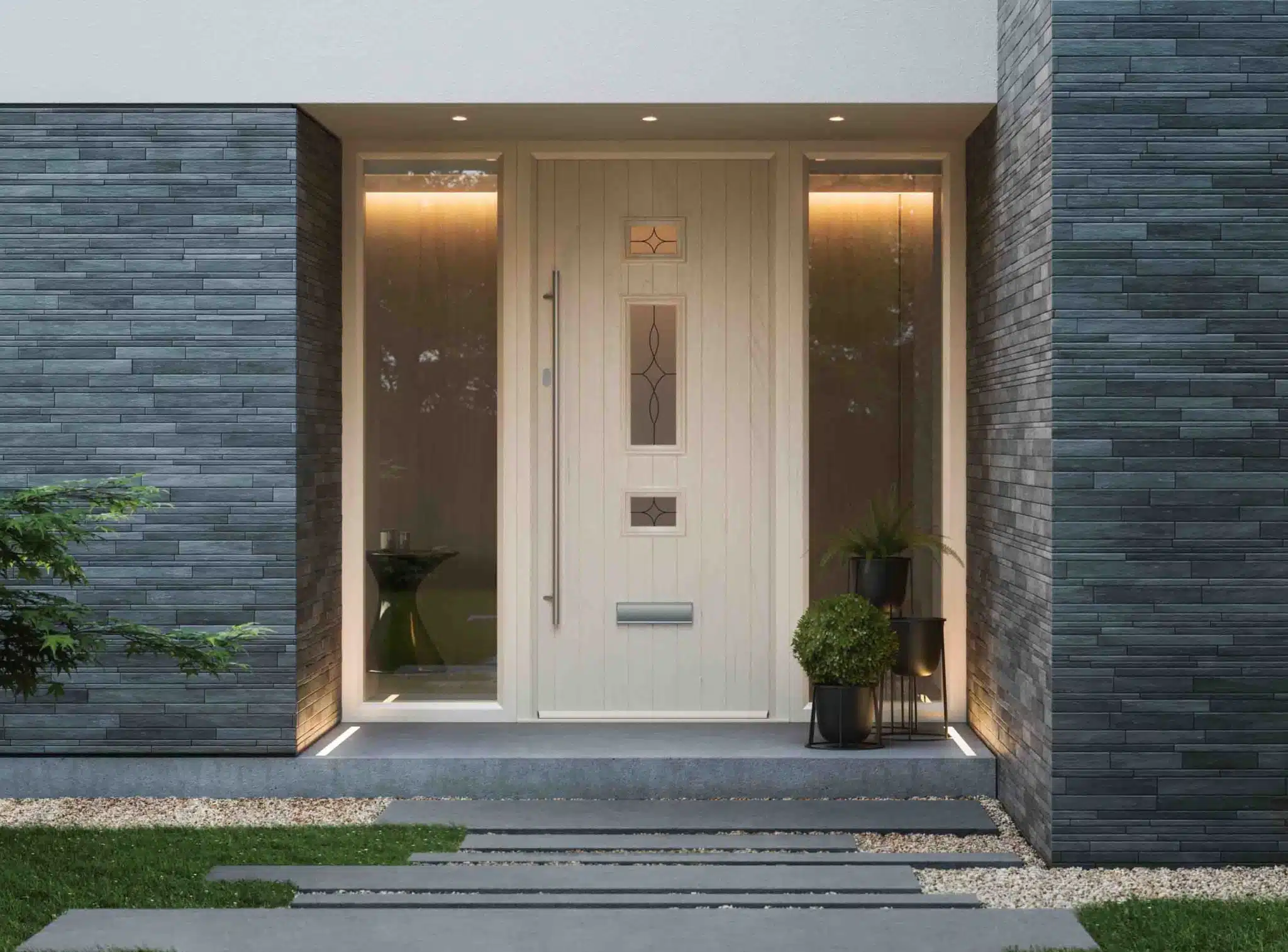
Doors in Caerphilly & Cardiff: Composite, Bifold & Patio
Daimant fits composite, uPVC, bifold and patio doors across Caerphilly and Cardiff. The right door depends on the job it has to do. For a front entrance, choose composite. To open onto the garden, choose bifold or patio. For a solid back or side entrance, composite wins again. Every door we fit is PAS 24 rated, Part L compliant and guaranteed by our own teams.

The right door depends on the job it has to do. For a front entrance where security and kerb appeal matter most, a composite door is the strongest all-round choice. To open the back of the house onto the garden, the decision is between bifold doors for a full-width opening and patio and sliding doors where space or budget is tighter. For a practical back or side entrance, a composite or a compact French set usually wins.
This page is a guide, not a sales list. We fit doors across Caerphilly, Cardiff and the Valleys from our Caerphilly base, and every one is built to the PAS 24 security standard, glazed for warmth and fitted by our own FENSA-registered teams. Below we match each common job to the right door, compare the options honestly and give guide prices, so you arrive at the child page already knowing roughly what you need. If you would rather talk it through on site, you can book a free survey and we will bring samples.
- Front door for security and looks: choose a composite door with a 3-star cylinder and PAS 24 rating.
- Full-width garden opening with the wow factor: choose bifold doors on a thermally broken aluminium frame.
- Garden access on a tighter budget or narrower opening: choose sliding or French patio doors.
- Every door we fit is built to PAS 24, glazed with warm-edge units and specified to clear Part L for warmth.
- All work is self-certified under FENSA and backed by a written guarantee, with your deposit protected.
- We survey, supply and fit across Caerphilly, Cardiff, Penarth, Rhiwbina and the wider Valleys, never subcontracting the fit.
Book a free home survey and we will look at the opening, talk through security, warmth and looks and give you a fixed price with no pressure.
Which type of door do you actually need?
Start with the job, not the product. Most homes need one of three things: a secure and welcoming front entrance, a way to open a living space onto the garden, or a solid, practical back or side door. Each job points to a different door, and choosing by job first saves you comparing products that were never right for the opening.
As a quick map: a front door calls for a composite door, where security and kerb appeal count for most. A wide rear opening calls for bifold doors if you want the whole wall to fold away, or sliding patio doors if you want a cleaner closed view and no swing space. A back or side door calls for a hard-wearing composite or a compact French pair. The rest of this page works through each of those in turn so you can head to the right detail page with a clear idea of what suits your home.

The solid core, 3-star cylinder and multi-point lock make it the strongest all-round choice for the front of the house.
Composite doorThe whole wall folds away to one side, the most dramatic opening for wide rear elevations and warm-weather living.
Bifold doorsA cleaner closed view and no swing or stacking space needed. French doors suit openings up to around 1.8 metres.
Sliding or French patioHard daily use, weather exposure and security on a quiet side return, composite shrugs off all three.
Composite or French set
front entrance
What is the most secure and best-looking front door?
For a front entrance, a composite door is the choice we recommend most often, because it answers the two things that matter at the front of a house at the same time: it is hard to break through and it looks the part. The construction is a solid 48mm timber core wrapped in a tough glass-reinforced plastic skin, so it resists the kick and shoulder attack that a hollow door cannot.
Security is built in rather than bolted on. A composite door from us runs a multi-point lock, a 3-star anti-snap cylinder to defeat lock snapping and the option of Secured by Design specification, the police-backed standard. It is also the door with the widest choice of colours, glass and hardware, so the same door that keeps the house safe is the one that lifts the front elevation. For the full detail on cylinders, cores and colours, see our composite doors page.
Resists kick and shoulder attack, weight and rigidity a hollow door cannot match
Multiple hooks and bolts engage around the frame simultaneously, not a single catch
Defeats lock snapping, the most common forced-entry technique on front doors
Police-backed specification, available on request across the composite range
A uPVC door costs less and is fine for a low-use side entrance, but for the front of the house a composite is worth the difference. The solid core gives it weight and rigidity a hollow uPVC panel cannot match, it holds colour better over the years and it carries the higher security specification more convincingly. If the front door is the one visitors see and the one a burglar would test first, put the money there.

How secure are your doors, and what is PAS 24?
Every external door we fit is built and tested to PAS 24, the enhanced security standard that a doorset has to pass as a complete unit, glass, frame, hinges and lock together, rather than as a strong-looking panel. It is the same standard insurers and the Secured by Design scheme look for, and it is why a Daimant door resists the common attacks: forcing, drilling, and lock snapping.
On the lock itself, our composite front doors carry a 3-star anti-snap cylinder, engineered to snap safely at a sacrificial line so the mechanism stays secure even if the outer section is attacked. Bifold and patio doors add anti-lift blocks so the panes cannot be jemmied out of the track, plus multi-point locking that throws hooks and bolts into the frame top and bottom. Laminated glass is available across the range so a pane holds together when struck. Security is the thread that runs through every door on this hub, whichever job it does.
Not just a strong frame, glass, hinges, locks and frame pass together as one unit
On composite front doors, snaps at a sacrificial line, keeping the mechanism secure
On bifold and patio doors, panes cannot be jemmied from the track; hooks and bolts throw top and bottom
Available across the range, a pane holds together when struck rather than shattering
Police-backed specification available on request across the door range
FENSA, guarantees and deposit protection
We are a FENSA-registered installer, which means we self-certify every door against the Building Regulations and register the work for you, so you receive the certificate without dealing with the council. That certificate matters when you come to sell the house, because a buyer's solicitor will ask for it.
Every door is backed by a written guarantee, and your deposit is protected through an insurance-backed scheme, so the money is safe even in the unlikely event something goes wrong before the fit. As a Caerphilly family firm with more than 20 years of experience, we fit with our own teams rather than subcontractors, across Cardiff, Caerphilly, Penarth, Rhiwbina and the Valleys, and stand behind the work long after the invoice. If a conservatory or an extension is part of the plan, our conservatories page shows how the doors tie into a warm, usable space.

Worked Examples
A Rhiwbina 1930s semi and a terraced house in Caerphilly.


A 1930s semi in Rhiwbina, Cardiff
A couple in Rhiwbina wanted to modernise the front of their 1930s semi and open up the kitchen at the back. At the front, the tired timber door was draughty and the lock felt flimsy, so we fitted a composite front door in a deep blue with a 3-star anti-snap cylinder, a multi-point lock and an obscure-glazed side panel to keep the hallway bright. The whole-door U-value came in around 1.4 W/m²K, and the hall stopped feeling cold by the door.
At the back, the opening was about 3 metres, so they had a genuine choice between bifolds and a slider. After standing in front of both, they chose a three-pane aluminium bifold in Anthracite Grey with a low threshold, so on summer weekends the kitchen runs straight out to the patio. Two jobs, two different doors, each matched to what that part of the house needed.
Two jobs, two different doors, each matched to what that part of the house needed.
A terraced house in Caerphilly
A homeowner in Caerphilly had a narrow rear opening of about 2.1 metres and a firm budget, but still wanted more light and easy garden access from the kitchen. A bifold would have been squeezed and pricey for that width, so we compared a French pair and a two-panel slider and let them try both at the showroom.
They chose a set of French doors with warm-edge double glazing, a low threshold for step-free access and laminated glass for security, which kept the cost at the lower end of the guide range. The side door, which took a beating from bins and bikes, was swapped for a hard-wearing composite in the same colour, so the back of the house looked tied together and every entrance met the same PAS 24 standard.
Back of the house looked tied together and every entrance met the same PAS 24 standard.