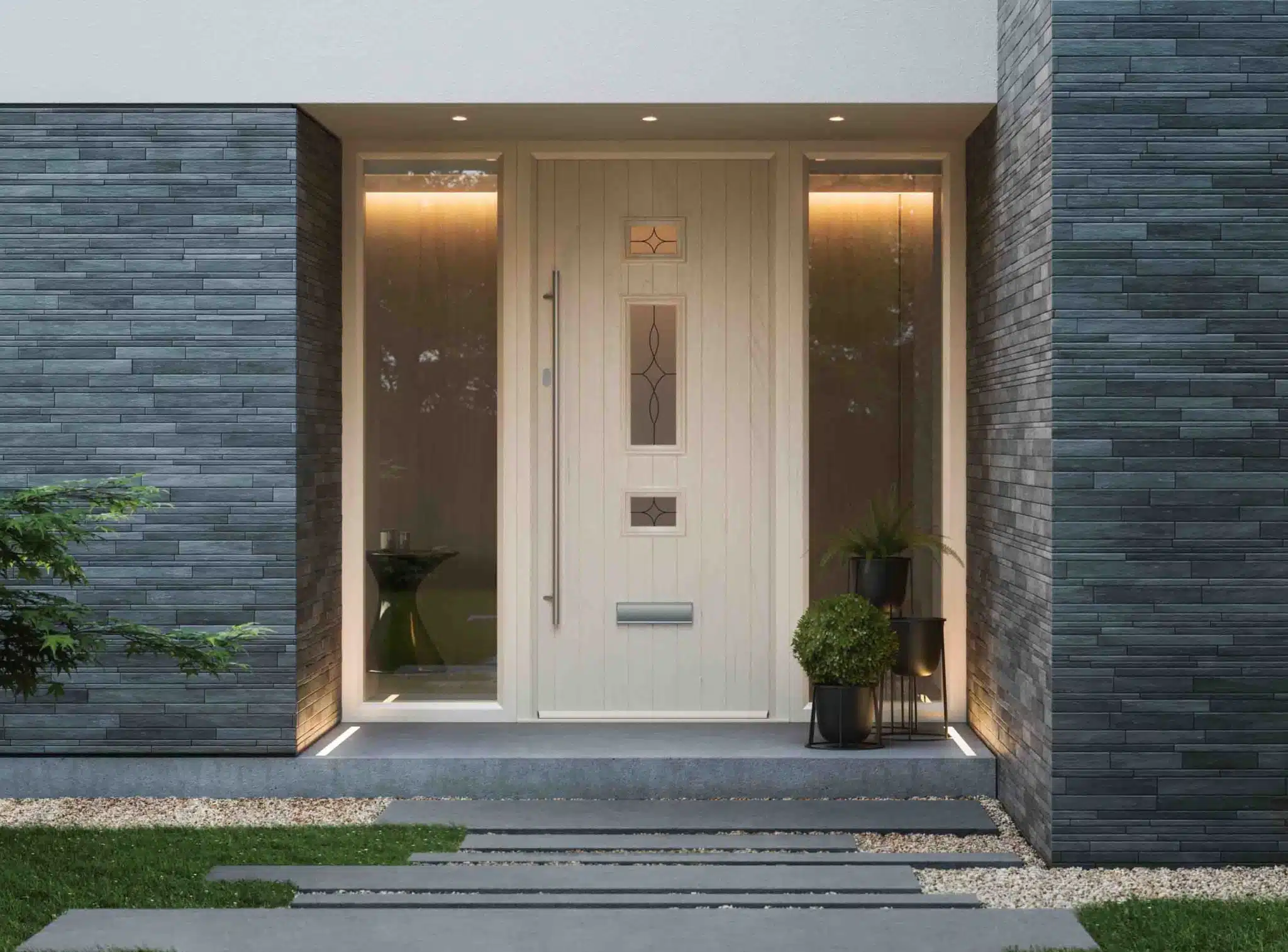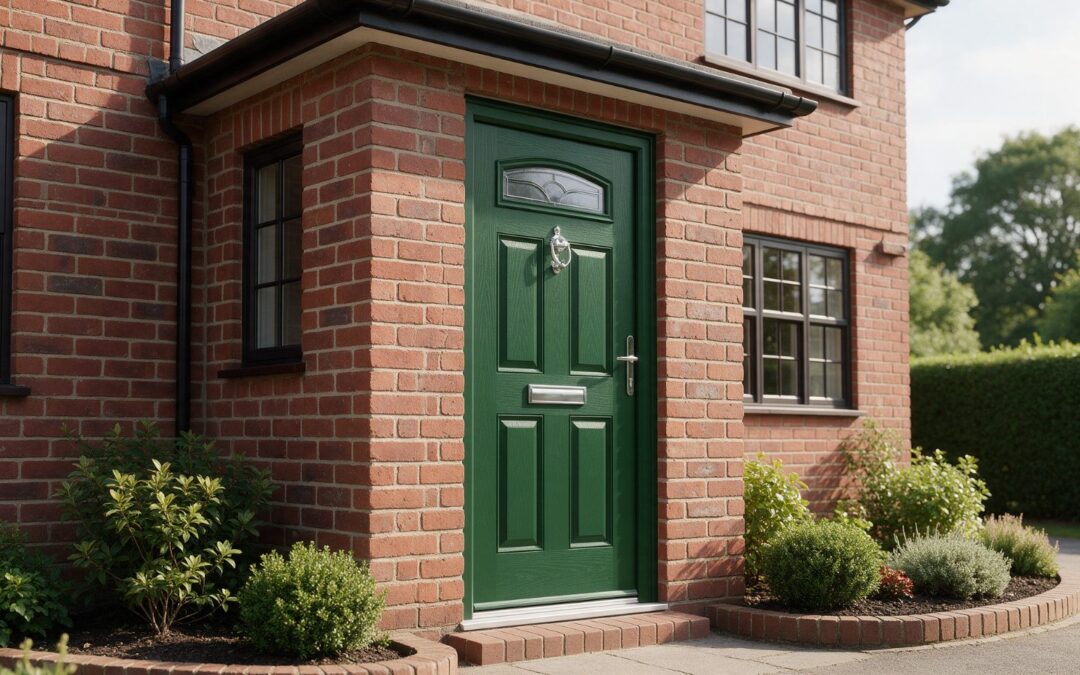
Composite front doors come in colours such as Anthracite Grey, Chartwell Green, racing green, deep blue, black, red and white, in a smooth or woodgrain finish, with contemporary, cottage and traditional panel styles. Daimant, the family-run installer based in Caerphilly, fits them across Cardiff and Caerphilly and brings samples to your door.
- FENSA registered
- 10-year insurance-backed guarantee
- Fixed written quote
- Our own Caerphilly fitting team
Fitted by our own Caerphilly team


What colours do composite front doors come in?
Composite front doors come in a wide range of colours, and the popular choices on the doors we fit are Anthracite Grey, Chartwell Green, racing green, deep blue, black, classic red and white, plus woodgrain effects. Other shades can be matched to a RAL colour where you need something specific.
A front door is the one part of the house you choose almost purely on looks, and it is easy to get stuck. A swatch the size of a stamp looks nothing like two square metres of colour in low winter light. That is why we bring samples to your door and hold them against your brick or render.
| Colour | Suits | Pairs well with |
|---|---|---|
| Anthracite Grey | New builds, rendered and modern homes | Grey or white windows, black or chrome handles |
| Chartwell Green | Period homes, stone cottages, 1930s semis | White or cream windows, chrome or gold tones |
| Racing green | Victorian and Edwardian terraces | White windows, gold tone or black hardware |
| Deep blue | Terraces and red brick houses | White windows, chrome hardware |
| Black | Most house styles | Any window colour, chrome or gold tones |
| Classic red | Red brick and cottage fronts | White windows, black or gold tone hardware |
| White | Homes with white windows and a plain front | White windows, chrome hardware |
- Popular colours include Anthracite Grey, Chartwell Green, racing green, deep blue, black, red and white, in smooth or woodgrain.
- Match the colour to the age of the house and the colour of your windows first, then to your taste.
- Style choices run from contemporary slabs to cottage and traditional four-panel doors.
- The colour runs through the GRP skin rather than sitting on top as paint, so it resists fading and never needs repainting.
- Colour and style do not change the security: every door we fit is PAS 24 with a 3-star anti-snap cylinder.
The colour list is long, so the useful question is which of those colours suits your particular house.
Which composite door colour suits your house?
The composite door colour that suits your house is usually the one that matches its age and building material, and sits comfortably with the window colour you already have. Darker heritage shades suit period brick and stone, while greys and blacks suit modern render and new builds.
Start by standing across the road. Look at the brick or stone, the window frames and the neighbours’ doors. A colour that fights the windows looks wrong however good it is on its own.
Victorian and Edwardian terraces
Terraces in Cardiff suburbs such as Roath and Canton, and Edwardian houses in Penarth, suit deep heritage colours. Racing green, deep blue, black and Chartwell Green all sit well against red brick and stone, and they suit the formal look of a period front.
1930s semis
Bay-fronted semis across Cardiff and Caerphilly suit Chartwell Green, black, deep blue and woodgrain effects. If the windows are white, almost any heritage shade works. If you are replacing windows at the same time, pick the door colour first and choose windows to suit. Our flush sash windows come in heritage colours such as Chartwell Green, which lets the door and windows match.
Stone cottages and valley terraces
Stone houses in the valleys around Caerphilly, Bargoed and Blackwood have warm grey and buff tones that suit Chartwell Green, black and woodgrain effects. Bright colours can look harsh against rough stone, while a muted heritage shade picks up the colour of the stone itself. A cottage style with a small window near the top of the door keeps the look simple and in proportion with low door openings. If the terrace has a row of matching doors, a colour close to the neighbours’ keeps the street looking like one piece.
New builds and rendered homes
Newer homes in places such as Ystrad Mynach, Newport and Pontypridd often suit Anthracite Grey or black, especially with grey windows. A contemporary style with a long bar handle finishes the look.
Should you choose a smooth or woodgrain finish?
Choose a woodgrain finish for a traditional or cottage-style house where you want the door to read as painted timber, and a smooth finish for a modern house with clean lines. Both finishes wear the same way.
Woodgrain has a raised texture you can see and feel, which catches the light like a painted timber door. On a stone cottage or a terrace, it is the more convincing choice. Smooth suits a contemporary slab, where the grain would look out of place. Look at both in daylight before deciding, because the difference is clearer in person than in a photo.

Which composite door style should you choose?
Choose a composite door style by matching it to the house: contemporary styles for modern homes, cottage styles for older and rural homes, and traditional four-panel or glazed-top styles for Victorian, Edwardian and 1930s houses. The style is the shape of the panels and glass on the slab.
- Contemporary. A flat or lightly grooved slab, often with a narrow strip of glass and a long bar handle. Suits new builds and modern extensions.
- Cottage. Vertical boards with a small square or arched window near the top. Suits cottages, stone houses and older rural homes.
- Traditional four-panel. Raised panels in the pattern of a Victorian timber door, sometimes with glass in the top two. Suits terraces and period semis.
- Half glazed. A top half of glass for maximum light in a dark hallway. Suits homes where the hall has no window of its own.
The glass and hardware change the character as much as the panels do. If you would like to see finished doors on real homes before choosing, our gallery of fitted work shows installs around Cardiff and the Valleys.
How much glass should your front door have?
Your front door should have as much glass as your hallway needs for light, balanced against privacy and security. A dark hall with no window suits a half-glazed or glazed-top door, while a door facing a busy street suits a small panel of obscure glass.
Most of our composite doors take a double-glazed decorative unit. You can specify warm-edge spacer bars and a low-emissivity coating so the glass panel does not become a cold spot in the door. If the door faces a road or a shared path, laminated or obscure glass adds privacy and makes the glazed section harder to break through. We talk through the trade-off between light, privacy and security on the survey.
Glass and warmth
A composite door holds a U-value of around 1.4 W/m²K thanks to its solid 48 millimetre timber core. A large glazed area changes that a little, which is why the glass specification matters. Our guide on whether composite doors are secure explains how laminated glass fits into the security side.
Which handles and hardware finish works best?
The hardware finish that works best is the one that matches the style of the door and the metal already on the house. Handles, letterplates, knockers and numerals come in chrome, black, satin and gold tones, and changing the finish changes the look of the door completely.
Chrome suits white, grey, blue and black doors and gives a clean, modern finish. Black hardware suits cottage doors and works well on red and green. Gold tones suit period doors in deep heritage colours. Satin gives a softer finish between chrome and black. Keep the finish the same across handle, letterplate, knocker and numerals, because mixing metals on one door looks accidental.

Will a composite door colour fade?
A composite door colour fades very slowly, because the colour runs through the glass reinforced plastic skin rather than being painted on the surface. It resists fading from sunlight far better than gloss paint, and it never peels or blisters.
South-facing doors in exposed spots will mellow very gradually over many years, as any surface does. What you will not get is the flaking and cracking that painted timber suffers, or the annual sanding and repainting. A wipe with warm soapy water two or three times a year keeps the door looking new. The GRP skin also keeps water out, so the door holds its shape through a wet winter and a dry summer. If you are still weighing a composite against a cheaper door, our guide to composite and uPVC front doors compares them side by side.
Does the colour or style change the price or the security?
The colour and style change the price a little, while the security stays the same, because every composite door we fit is a PAS 24 tested doorset with a 3-star anti-snap cylinder and a multi-point lock. Glass and hardware move the price more than colour does.
Checkatrade’s August 2024 guide puts a basic composite door, supplied and fitted without glass, at about £1,600 to £2,400. Glazing, hardware and size move it from there. Our guide to composite door costs in Cardiff sets out what adds to a quote and what cheaper quotes leave out.
A strong-looking door is only as secure as its frame and lock, so we quote the tested doorset rather than a slab fitted into a soft surround. You choose the look; the security specification comes as standard.
How do you choose your composite door colour and style?
Choose your composite door colour and style in five steps: look at the house, pick a style, narrow the colours, decide on glass and choose the hardware. Doing it in that order stops a favourite colour leading you to the wrong door.
Photograph the front of the house
Take a photo in daylight from across the road. Note the age of the house, the brick or stone and the window colour.
Pick the style
Choose contemporary, cottage, traditional panel or half glazed to suit the age of the house.
Shortlist two or three colours
Use the table above to shortlist colours that suit your house and windows.
Decide on glass
Choose how much light the hall needs and how much privacy the street allows.
See samples on your doorstep
Book a free survey. We bring colour samples, measure the opening and give you a fixed written price.
We fit composite doors across Cardiff and Caerphilly, and in Newport, Penarth, Barry, Bridgend, Pontypridd, Cwmbran, Pontypool and Blackwood.
A door looks different on your doorstep than on a screen, and the samples settle it quickly. For the full specification, including the Door-Stop doorsets we fit, the security and the U-value, see our composite doors in Cardiff and Caerphilly page.
Frequently asked questions
Popular choices on the doors we fit include Anthracite Grey, Chartwell Green, racing green, deep blue, black and classic red.
Ask on your survey. Options depend on the door range and colour, and we confirm what is available for the door you choose.
You should not need to. The colour runs through the skin and does not peel, so the door keeps its finish without painting.
Most homes do not. Homes in a conservation area covered by an Article 4 Direction, and listed buildings, may need consent, so check with your council first.
Yes. The survey is free, and the quote that follows is fixed, in writing and with no obligation to go ahead.