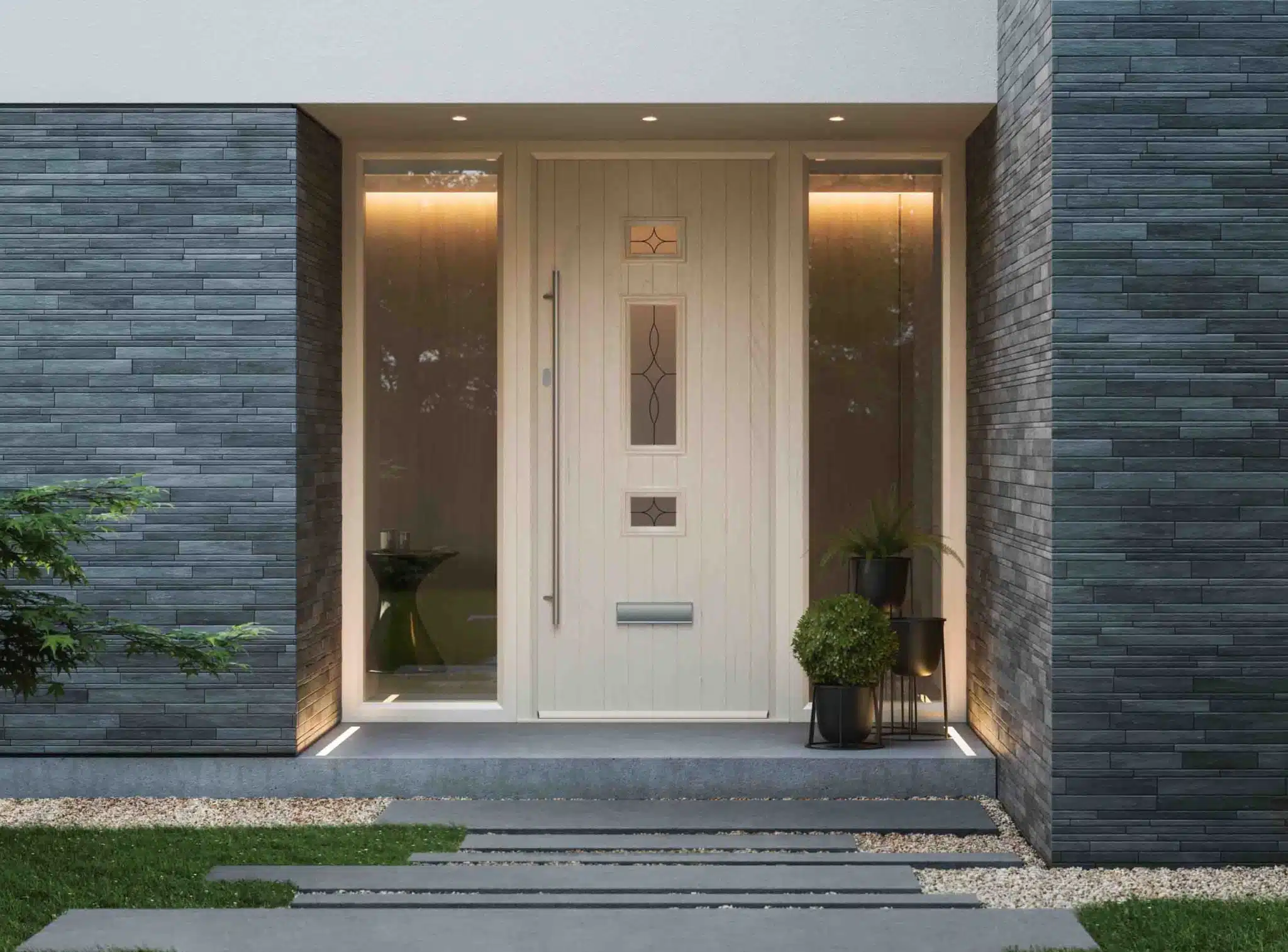
Daimant supplies and fits uPVC front, back and side doors for homes across Cardiff and Caerphilly, with our own fitting team working from our Caerphilly base. A uPVC door gives you a secure, well insulated, low maintenance entrance for less than a composite door, and every one we fit has multi-point locking and an anti-snap cylinder.
- FENSA registered
- 10-year insurance-backed guarantee
- Fixed written quote
- Our own Caerphilly fitting team
Fitted by our own Caerphilly team


What is a uPVC door, and where does it suit best?
A uPVC door is a front, back or side door built from rigid PVC profiles, reinforced inside the frame, with an insulated panel or a glazed unit in the middle, and it suits everyday entrances where low upkeep and price matter most. The frame and panel need no painting. Your old door might stick in winter, let a draught in under the threshold or need the key jiggled before it locks. A new uPVC doorset takes care of all three for a modest outlay.
uPVC is a good fit at the back of the house onto the garden, down a side passage, into a utility room or kitchen, and at the front of modern and post-war houses. Daimant fits uPVC alongside our full range of doors, so one survey can cover every opening in the house.
- uPVC suits front, back, side and utility doors, and costs less than a composite door.
- Daimant fits multi-point locking and anti-snap cylinders, with PAS 24 and Secured by Design available.
- You get a fixed written price after a free survey, plus a 10-year insurance-backed guarantee.
- A listed building, or a period front in a conservation area, may call for a different door or council consent.
Front, back and side doors: which style suits which opening?
The right uPVC door style depends on the opening: a front door needs security and kerb appeal, a back door needs light and easy daily use, and a side or utility door needs strength and privacy above all. The table covers what to ask for at each one.
| Opening | What the door does | Style to consider | Glass | Hardware to ask about |
|---|---|---|---|---|
| Front door | Main entrance and the first thing visitors see | Panel door with a glass design, or a solid door with a glazed side panel | Decorative or obscure glass | Letterplate, knocker, house numerals, spyhole |
| Back door | Garden access, bins, washing and pets | Half glazed or fully glazed door | Clear safety glass for light, or obscure glass | Lever handles and a lock you can key from both sides |
| Side door | Access along the side of the house or into a garage | Solid or part glazed door | Obscure glass or none | Multi-point lock and anti-snap cylinder |
| Utility door | Laundry room, kitchen or rear extension | Half glazed door | Obscure glass where the door faces a neighbour | Lever handles and a letterplate only if post comes this way |
A back door gets far more use than a front door in a lot of homes. Tell your surveyor how you use each door, and the specification follows from that.
How secure is a modern uPVC door?
A modern uPVC door is secure when it has a multi-point lock that bolts into the frame at several points, an anti-snap cylinder, and a reinforced frame fixed firmly into the wall, and Daimant fits that specification on every uPVC door. The weak spot on older doors is usually the cylinder. A standard euro cylinder can be snapped with hand tools, and a cylinder that sticks out past the handle is an easy target.
Daimant windows and doors are available to PAS 24, the UK security test for complete doorsets, and to Secured by Design, the police security initiative. You can ask for either on your quote. Fitting counts too: a door that drops on its hinges stops the bolts lining up with the keeps, so the frame has to go in square and packed tight. Our guide to door security standards covers the tests in more detail.
Glazing, colour and hardware options
uPVC door options cover the glass, the colour and the hardware, so you can match a new door to the house and to your windows, and Daimant confirms every choice on your written quote before anything is ordered. These are the choices to think about before the survey.
Glazing
- Clear double glazed units give a dark hallway or kitchen more light.
- Obscure glass keeps privacy on a street-facing front door or a door beside a bathroom.
- Georgian bar designs suit a period-style front.
- Decorative glass designs give a front door some character without losing privacy.
Colour
- White is the standard uPVC finish and matches most existing white windows.
- Woodgrain foil finishes give the look of timber with the same easy upkeep.
- Solid colours let you pick a front door colour that suits the street.
Hardware
- Handles: lever pads for back doors, lever or long pull handles for front doors, in a finish to match your other fittings.
- Letterplates, knockers, numerals and spyholes can finish the front door.
- A door chain or restrictor if you want to answer the door with it held.

What does a uPVC door cost fitted?
A uPVC front door costs roughly £350 to £950 for the door alone, according to Checkatrade’s composite door buying guide (updated August 2024), and fitting, the frame, your glass choice and removal of the old door add to that figure. Daimant prices every door from a free survey and gives you a fixed written quote, so the figure you sign is the figure you pay.
| Door type | Published benchmark | What moves the price |
|---|---|---|
| uPVC front door | £350 to £950, door only (Checkatrade, August 2024) | Glass design, colour, side panel, hardware |
| uPVC back door | Priced on your survey | Amount of glass, threshold, lock specification |
| uPVC side or utility door | Priced on your survey | Size of the opening, glass, lock specification |
| Composite front door, for comparison | About £1,600 to £2,400 supplied and fitted, basic specification without glass (Checkatrade, August 2024) | Glass, colour, side panel, top light, hardware |
The gap between the two materials is the main reason to choose uPVC. Our guide on composite or uPVC sets out what the extra money buys.
How is a door replaced?
A door replacement with Daimant runs in four stages: a free survey and measure, removal of the old door, fitting and fixing the new doorset, then finishing the edges and testing every lock before the fitters leave your home. Your surveyor gives you the timetable in writing.
Survey and measure
The surveyor measures the opening, checks the existing frame and threshold, talks through glass, colour and hardware, and gives you a fixed written quote with no obligation.
Order and timetable
Your door is made to the measured size. Your surveyor gives you the timetable in writing, so you know when the fitters arrive.
Remove and fit
Our own fitting team takes out the old door, fits the new doorset square in the opening, fixes it into the wall and sets the threshold.
Finish and hand over
The team seals the outside, trims the inside, tests the locks and handles, and hands you the keys and guarantee paperwork. Daimant is FENSA registered, so the replacement is recorded for building regulations.
Every door carries a 10-year insurance-backed guarantee. Our guide to how deposits and guarantees are protected covers the paperwork you receive.

When is uPVC the wrong choice?
uPVC is the wrong choice for a listed building, for a period front door in a conservation area with an Article 4 Direction, and for a very exposed elevation, where a stiffer composite slab tends to resist flexing and draughts better. Listed buildings need consent for changes like this, so speak to the council before you order anything.
Cardiff Council has 27 conservation areas, and many of them, including Roath Park and Llandaff, have Article 4 Directions that control minor alterations such as windows. Caerphilly County Borough Council designates its own conservation areas and publishes a map. You should check yours before you choose a new front door. For a front door that faces the weather, our composite front doors give you a thicker, harder slab at a higher price.
Door fitting across Caerphilly and Cardiff
Daimant fits uPVC doors across Caerphilly county borough and Cardiff from our base in Caerphilly, using our own fitting team, and we also fit doors in Newport, Pontypridd, Penarth, Barry and Bridgend. The areas we cover are:
- Caerphilly county borough, where the business is based
- Cardiff, including the conservation areas mentioned above
- Newport, Pontypridd, Penarth, Barry and Bridgend
Some people search for us as Diamond Windows or Diamant Doors, and you have found the same family-run firm. Phone 029 2002 3280, Monday to Friday 9:00am to 4:30pm, or see our page on windows and doors in Cardiff.
Frequently asked questions
A uPVC door is made and hung in its own frame, so the door and frame are normally replaced together. Your surveyor looks at the existing frame on the free survey and tells you what your opening needs.
Yes. White and woodgrain foil finishes can be matched to existing uPVC windows, and your surveyor compares the colour against your windows during the survey.
Wipe the frame and panel with soapy water a few times a year, keep the drainage slots in the threshold clear, and put a drop of light oil on the lock and hinges once a year.
A replacement external door has to meet building regulations. Daimant is FENSA registered, so the work is registered through FENSA and you do not need to make a separate application.