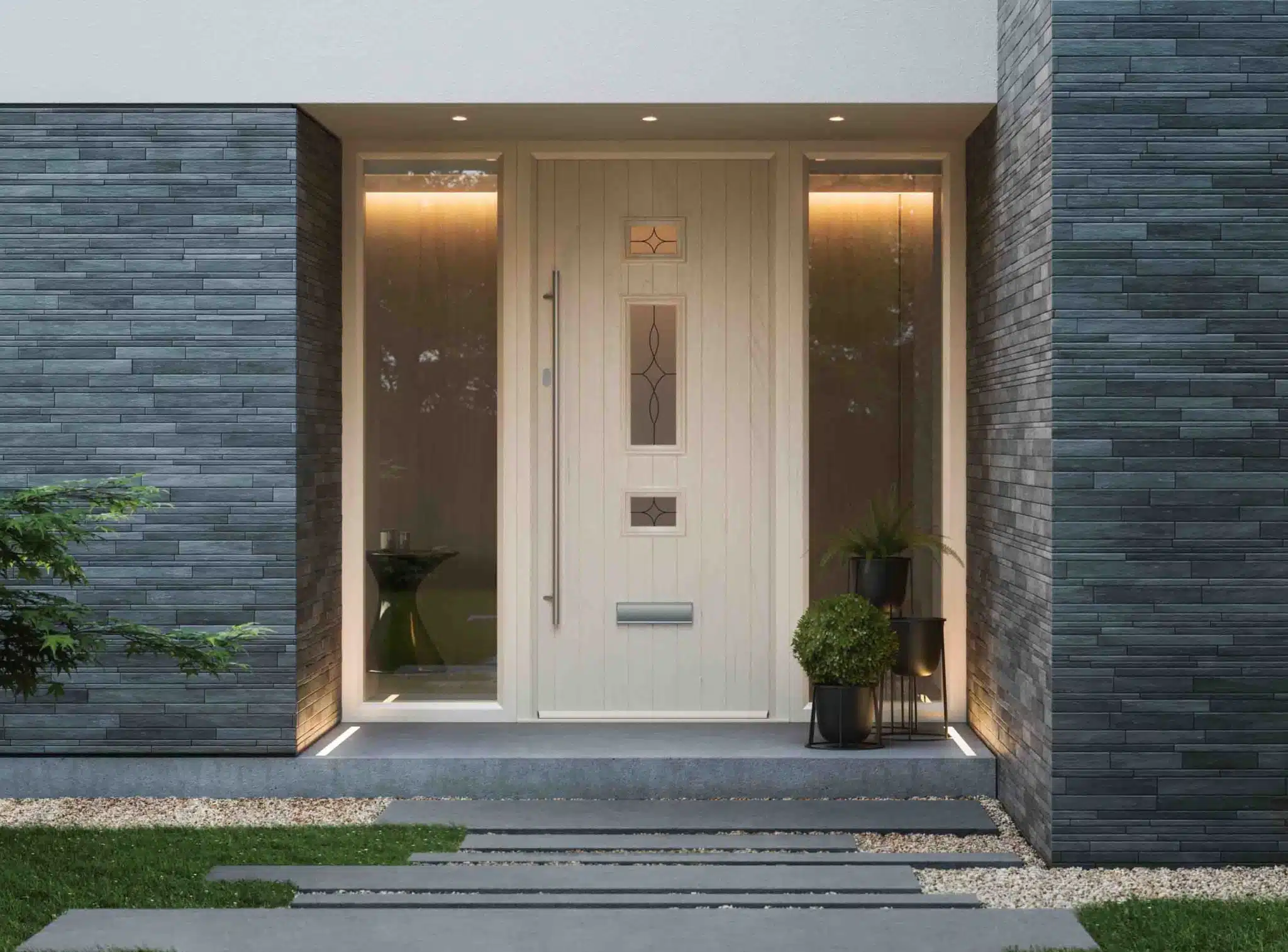
Daimant fits both composite and uPVC front doors for homes across Cardiff and Caerphilly, and for a main front door a composite door is usually the stronger, better insulated choice. A uPVC door costs less, suits back and side doors well, and gives landlords and tighter budgets a secure door for a lower outlay.
- FENSA registered
- 10-year insurance-backed guarantee
- Fixed written quote
- Our own Caerphilly fitting team
Fitted by our own Caerphilly team


Composite vs uPVC front door: which is better?
A composite front door is the better choice for a main entrance when your budget allows, as its thicker insulated slab resists knocks and flexing, while a uPVC door is the better value choice for back doors, side doors and rentals. The condition that decides it is money.
Both doors can carry the same locks and reach the same tested security standard. The difference sits in the slab: a composite slab is solid and heavy, while uPVC uses a lighter infill panel in a reinforced frame. You pay more for the composite, and in return you get a harder surface, better insulation through the door itself and a finish that holds its colour. If the extra cost would stretch you, a well specified uPVC door is a sound front door.
- Composite suits a main front door, and uPVC suits back doors, side doors, rentals and tighter budgets.
- Both can have a multi-point lock, an anti-snap cylinder and PAS 24 and Secured by Design security.
- A composite door is the dearer option, and the price section below sets out the published benchmarks.
- Daimant fits both, so one free survey can price a composite front door and a uPVC back door together.
Which is more secure?
A composite door and a uPVC door can reach the same tested security level, PAS 24 and Secured by Design, when both have a multi-point lock and an anti-snap cylinder, and the composite adds a harder, thicker slab on top. The lock and cylinder decide more than the material does.
| Feature | Composite door | uPVC door |
|---|---|---|
| Construction | GRP skin over a solid timber or foam core | uPVC infill panel or glass in a reinforced uPVC frame |
| Slab | Thick, solid and heavy | Thinner, lighter panel |
| Locking | Multi-point lock | Multi-point lock |
| Cylinder to ask for | Anti-snap, rated TS007 3 star | Anti-snap, rated TS007 3 star |
| Standards Daimant offers | PAS 24, Secured by Design | PAS 24, Secured by Design |
| Guarantee | 10 years, insurance-backed | 10 years, insurance-backed |
TS007 is the kitemark rating for cylinders, and 3 star is the top grade on the cylinder alone. Our guide on how secure composite doors are covers the tests in detail.
Which is warmer?
A composite door is usually the warmer of the two: its slab carries an insulated core through the full thickness of the door, while a uPVC door relies on a thinner infill panel that holds less insulation between its outer faces. Glass and fitting can narrow or widen the gap.
| Where heat escapes | Composite door | uPVC door |
|---|---|---|
| Door slab or panel | Thick insulated core through the slab | Thinner insulated infill panel |
| Glass | Double glazed units, and more glass means more heat loss than solid slab | Double glazed units, with the same trade-off |
| Frame | Reinforced frame made for the doorset | Reinforced multi-chambered uPVC frame |
| Seals and threshold | Depend on fitting and on a new threshold | Depend on fitting and on a new threshold |
Each doorset has a U-value from its manufacturer, and a lower number means less heat lost. You can ask for the U-value of the exact design on your quote. A door with a large glazed area can lose more heat than a solid one of the other material.
Which lasts longer, and do composite doors warp?
A composite door usually lasts longer than a uPVC door, as the GRP skin resists dents, scratches and fading, although a dark composite door can bow slightly in strong direct sun on a south-facing front. A lighter colour or a door in a sheltered porch reduces that risk.
A timber core can swell if water gets into it through a damaged edge or a failed seal. Good fitting and a sound threshold keep water out. A uPVC door is lighter, so its frame and hinges carry less load, though its panel dents more easily and a woodgrain foil can lift at the edges on older doors. White uPVC holds up well on a back or side door that sees daily use.
Upkeep is much the same for both. Wipe the door with soapy water a few times a year, keep the drainage slots in the threshold clear, and oil the lock and hinges once a year.

How do the prices compare?
A composite front door is the dearer of the two: Checkatrade’s composite door buying guide (updated August 2024) puts a basic composite door at about £1,600 to £2,400 supplied and fitted, against £350 to £950 for a uPVC front door alone. The two figures cover different things.
| Door | Checkatrade benchmark | What the figure covers |
|---|---|---|
| Composite front door | About £1,600 to £2,400 | Supplied and fitted, basic specification without glass |
| uPVC front door | £350 to £950 | Door only, before fitting |
The composite figure includes fitting and the uPVC figure does not, so the real gap is smaller than the table suggests. Daimant gives you a fixed written price for either door after a free survey. For a full breakdown of what adds to a composite quote, see our guide to composite door prices in Cardiff.
Which suits a terrace, a semi or a rental?
The better door depends on the house: a composite door usually suits a terraced front that opens onto the street, either door suits a semi, and uPVC often suits a rental, where price and simple upkeep count for more. Each case below has its own reasons.
Terrace
A terraced front door faces the pavement, so security and appearance both matter, and a composite door gives you both. Cardiff Council has 27 conservation areas, and many of them, including Roath Park and Llandaff, have Article 4 Directions that control minor alterations such as windows. You should check with the council before changing a front door in one of those streets.
Semi
A semi has room for both. A composite front door with uPVC back and side doors keeps the higher spend where visitors see it, and the back door gets a lighter door for daily use.
Rental
A landlord gets a secure, easy to clean door for a lower outlay with uPVC. A door is one small item on an EPC, so the choice of material has little effect on the rating. Our uPVC front and back doors page lists the styles and hardware available.

What is inside a composite door?
A composite door is built in layers: a tough glass reinforced plastic (GRP) skin on each face, a solid core of timber or insulating foam between them, and a reinforced frame around the whole slab. Each layer has its own job.
- GRP skin. The outer faces take knocks and weather and carry the colour and wood grain texture.
- Core. A timber core adds weight and stiffness, and a foam core adds insulation.
- Frame. The frame holds the slab square and takes the locking points and hinges.
A uPVC door works differently. Its frame is uPVC with steel reinforcement inside, and the middle of the door is an infill panel of uPVC sheets over insulating foam, or a glazed unit.
Where can you see both doors?
You can see both door types on a free survey with Daimant, where the surveyor talks you through colours, glass and hardware for composite and uPVC doors at your own front door, and in the fitted work on our gallery page. Daimant is based in Caerphilly and fits across Caerphilly county borough and Cardiff. If the verdict points to composite, the next question is which specification and which colour, and our page on composite doors covers both.
Frequently asked questions
Yes. Daimant fits both, so one free survey can price a composite front door and a uPVC back door together, with colours matched across the house.
A composite door comes in its finished colour and needs no painting. You should check with the manufacturer before painting one, as it can affect the guarantee.
Yes. The solid slab makes a composite door noticeably heavier, and it is hung on heavy duty hinges in a frame made to carry that weight.
Replacing a front door on an ordinary house does not usually need planning permission. A listed building, or a Cardiff conservation area with an Article 4 Direction, can need consent, so check with the council first.