You need new windows when misting between the panes, draughts, sticking sashes, weak locks or rotting frames keep coming back after repair. Daimant, the family-run installer based in Caerphilly, checks windows across Cardiff and Caerphilly on a free survey and tells you plainly which ones need replacing.
- FENSA registered
- 10-year insurance-backed guarantee
- Fixed written quote
- Our own Caerphilly fitting team
Fitted by our own Caerphilly team


When should you replace your windows?
Replace your windows when the same faults keep returning after repair, or when the frames themselves have failed. Eight signs point that way: misting between the panes, draughts, cold spots, sticking sashes, locks that no longer hold, rotting or warped frames, heavy condensation and a poor EPC rating.
One sign on one window is usually a repair. Several signs across the house usually mean the windows have reached the end of their working life. Double glazing fitted in the 1990s or early 2000s is now old enough for its seals and hinges to wear out.
| Sign | What it usually means | Repair or replace? |
|---|---|---|
| Misting between the panes | The seal on the glass unit has failed | New glass unit if the frame is sound |
| Draughts around the sash | Worn seals, dropped sash or failed hinges | Repair first; replace if the frame has moved |
| Cold spots near the window | Old glass with a poor U-value | Replace for a real gain |
| Sashes that stick or drop | Worn hinges or a distorted frame | Repair hinges; replace a distorted frame |
| Locks that do not hold | Worn or outdated locking gear | Replace if the frame cannot take modern locks |
| Rot, warping or cracking | Frame failure | Replace |
| Heavy condensation inside | Cold glass plus poor ventilation | Check ventilation; replace old single or early double glazing |
| Poor EPC rating for glazing | Old glazing scoring badly | Replace |
- One fault on one window is usually a repair; the same faults across the house point to replacement.
- Misting between the panes means a failed seal, and a sound frame can often take a new glass unit.
- Old single glazing loses heat at a U-value near 5.0; the A-rated windows we fit sit around 1.2 W/m²K.
- Replacement windows in Wales must meet building regulations, and a FENSA certificate proves they do.
- A free survey tells you which windows to replace and which to keep.
Misting is usually the first sign you notice, so it is the right place to start.
Does misting between the panes mean you need new windows?
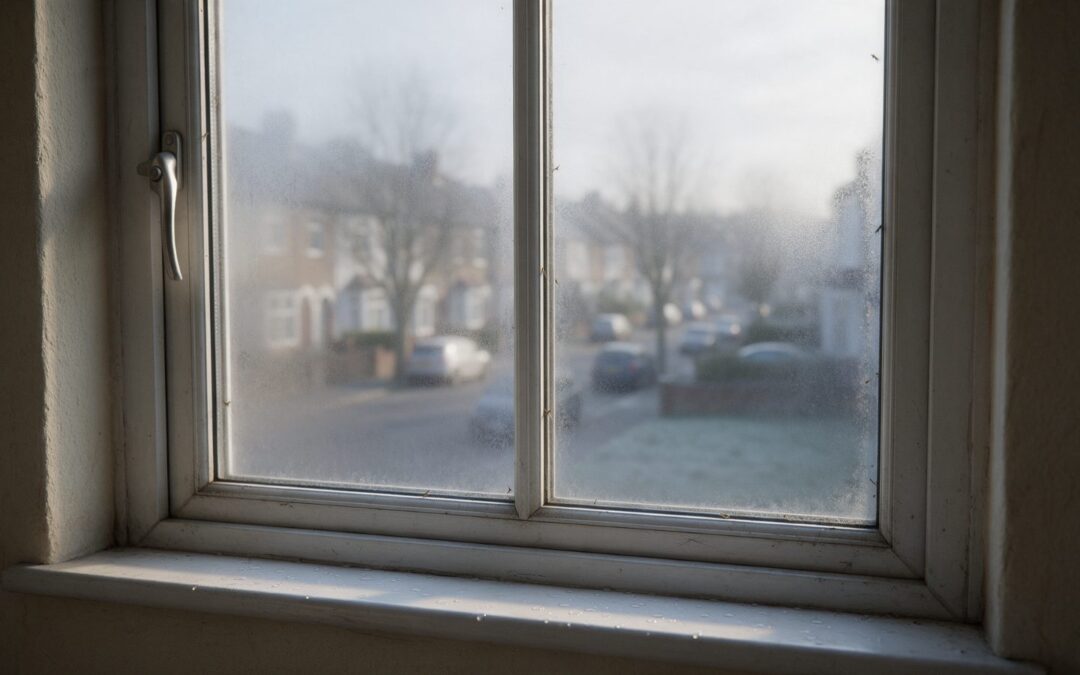
Misting between the panes means the seal around the double glazed unit has failed, letting damp air into the gap, but it does not always mean you need a whole new window. A new sealed unit can go into a frame that is still square, secure and free of rot.
The misting will not clear on its own, and wiping the glass does nothing because the moisture is inside the unit. The unit has also lost its insulating gas, so it is colder than it was. If only one or two windows are affected and the frames are sound, a new glass unit is the sensible fix. If most of the windows are misting, the seals are failing together because they are the same age, and replacing the windows is usually the better use of your money.
The same applies to conservatories, where misted roof and side panels are a common fault. Our conservatory repairs page covers misted units, leaks and failed seals in conservatories.
Do draughts and cold spots mean your windows have failed?
Draughts and cold spots mean your windows are losing heat, either through worn seals and dropped sashes or through old glass that insulates poorly. Old single glazing has a U-value near 5.0, while the A-rated windows we fit sit around 1.2 W/m²K, so the difference is large.
Hold the back of your hand near the edge of each opening sash on a windy day. A draught along the edge points to a worn seal or a sash that has dropped on its hinges, and those can sometimes be adjusted. A room that feels cold near the window even with no draught points to the glass itself, and no adjustment fixes that.
What the numbers mean for your house
A U-value measures how fast heat escapes through a square metre of window, so a lower number is better. Replacing old glazing with A-rated units cuts that loss, and it is also one of the things an energy assessor scores. Our guide on whether new windows improve your EPC rating explains the gain in more detail.

Is condensation on the inside of the glass a window problem?
Condensation on the inside of the glass is partly a window problem and partly a ventilation problem: warm, damp air meets a cold surface and turns to water. Old glass is colder on the inside face, so it collects more condensation than a modern A-rated unit.
Streams of water on the sill every winter morning, black mould in the corners of the reveal and peeling paint below the window are the signs that condensation has become a problem. New windows with warm-edge spacers keep the inner pane warmer, which reduces condensation on the glass. Ventilation still matters, and the building regulations set higher ventilation levels for rooms where steam is produced, such as kitchens and bathrooms. We look at trickle vents and ventilation for each room on the survey.
Condensation outside the glass
Condensation on the outside of the glass on a cold morning is a good sign. It means the window is keeping heat in so well that the outer pane stays cold. It clears as the day warms up.
Are old windows a security risk?
Old windows are a security risk when the locks are worn, the hinges are exposed or the frame can be levered away from the sash. Modern windows built to PAS 24 are tested as a complete window against those attacks, with multi-point locking that holds the sash at several points.
A window from the early 1990s often has a single-point lock and a handle that lifts with little effort. Check each window by locking it and pressing firmly on the sash near the handle and at the far corner. Movement at either point means the lock is no longer holding the sash tight. Every window we fit is built to PAS 24, and Secured by Design is available where an insurer asks for it.
Do sticking, rotting or yellowed frames mean you need replacements?
Rotting, warped or cracked frames mean you need replacement windows, while sticking sashes and yellowed uPVC can sometimes be repaired or lived with. The frame is the part that holds the glass, the locks and the seals, so once it fails nothing fitted to it works properly.
On timber windows, push a screwdriver gently into the bottom rail and the sill. Soft wood that gives way is rot, and it spreads. On uPVC windows, look for cracks at the corners and a frame that has bowed away from the wall. Yellowing on older white uPVC is mostly cosmetic. A sash that has to be lifted to close usually has worn hinges, and new hinges may fix it if the frame is square. If the frames have gone, our window replacement cost guide for Cardiff sets out the likely spend.

Should you replace windows before selling or letting a house?
Replacing windows before selling or letting makes sense when the glazing is dragging down the EPC rating or when buyers are likely to question the condition of the frames. A FENSA certificate for the new windows is needed when you sell, because it proves the work met building regulations.
FENSA’s own guidance says you need its certificate when you sell a property. It confirms the windows comply with building regulations and that the installation was registered with the local council. When a FENSA registered installer such as Daimant fits your windows, you receive that certificate after the job. Our guide on deposit protection, FENSA and guarantees explains what each document protects.
What rules apply when you replace windows in Wales?
Replacement windows in Wales must meet building regulations, which have applied to all replacement glazing since 1 April 2002, according to the Welsh Government. The rules cover energy efficiency, safety glazing in critical areas, means of escape and ventilation.
A registered installer can self-certify that work through a competent person scheme, so you do not need to involve building control yourself. Our guide to building regulations and FENSA for replacement windows in Wales explains the certificate in full. The rules you are most likely to meet are these:
- Energy efficiency. The new window has to meet the U-value limit set in the Welsh approved document for energy.
- Safety glazing. Glass in critical areas, such as within 800 millimetres of the floor, must be safety glass.
- Means of escape. A replacement window must give at least the same potential for escape as the old one. Escape windows need a clear opening of at least 0.33 square metres, and at least 450 millimetres high and wide.
- Ventilation. Rooms need adequate ventilation, with higher levels where steam is produced.
Escape rules matter most in upstairs rooms and flats. If you have children, restrictors and escape need to be planned together, and we cover both on the survey.
How do you check your windows room by room?
Check your windows room by room with a notebook and ten minutes per floor, testing the glass, the seals, the locks and the frames on each one. The list you end up with tells you whether you need a few repairs or a full replacement.
Look through the glass
Note any window with misting or a milky film between the panes. Write down which rooms they are in.
Feel for draughts
On a windy day, run the back of your hand around each opening sash. Mark any window with a draught along the edge.
Test the locks
Lock each window and press on the sash by the handle and at the far corner. Mark any that move.
Check the frames
Look for rot, cracks, bowing and sashes that have to be lifted to close.
Count the faults
If most windows have two or more marks, replacement is likely to be better value than repair. Book a survey and we will confirm window by window.
The survey comes with a fixed written price for the windows you do need, and it costs nothing. We cover Cardiff and Caerphilly and fit in Newport, Penarth, Barry, Bridgend, Pontypridd, Cwmbran, Pontypool and Blackwood.
Once you know which windows need to go, the next choice is what replaces them. Our replacement windows in Caerphilly and Cardiff page compares casement, flush sash, sliding sash and tilt and turn windows side by side.
Frequently asked questions
Well-made uPVC windows commonly last 20 years or more. The glass seals and hinges usually wear before the frame, and those parts can often be replaced.
Yes. You can replace the worst windows first, or the front of the house first. We help you match colour and style so the new windows sit well with the old ones.
New windows reduce condensation on the glass because the inner pane stays warmer. Good ventilation is still needed, especially in kitchens and bathrooms.
Most homes do not need planning permission for like-for-like windows. Homes in a conservation area with an Article 4 Direction, and listed buildings, may need consent, so check with your council first.
Yes. The survey is free, and the quote that follows is fixed, in writing and with no obligation to go ahead.